Tie a client's Shopify sales out before close.
Net Sales checked against Shopify to the cent, every held-out order named, and a PDF you can hand over.
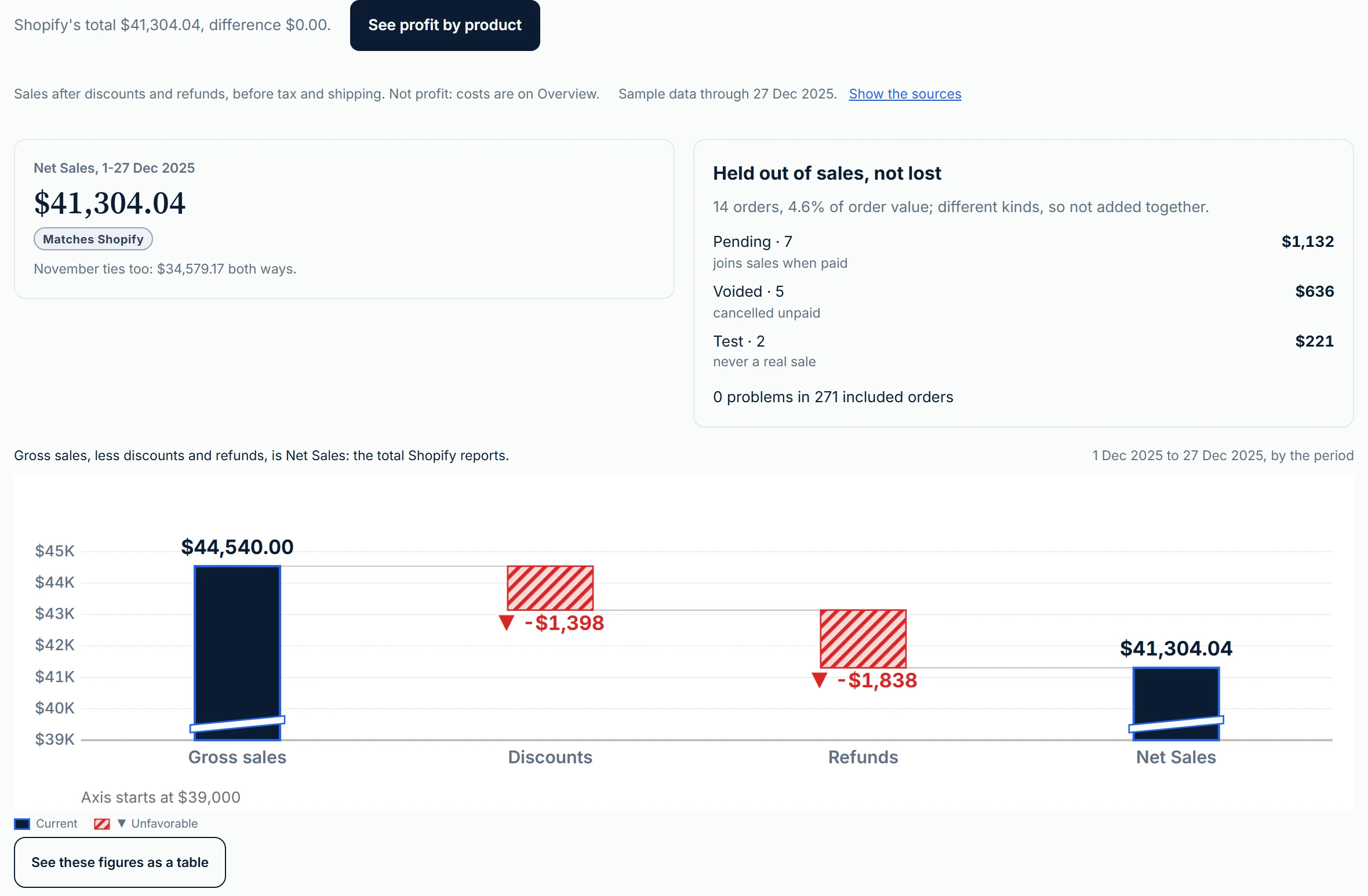
Sample data On the sample store, $41,304.04 of Net Sales matches Shopify to the cent: difference $0.00, 14 orders held out, each with a reason.
What you hand the client
Net Sales tied to Shopify, with Shopify’s own total and the difference beside it, and every excluded order named. Both come from Trust > Exports.
Pending: 7 orders. Not yet paid. They join sales when they settle.
Voided: 5 orders. Cancelled before payment.
Test: 2 orders. Test orders, never real sales.
Different kinds, so they are never added together.
Each cost names its source. Meta ad spend you upload is checked against the Meta bill. A cost with no source is left out by name, never estimated.
Three steps, on one client store
- Install it on one client store.
From the Shopify App Store, on the store whose sales you are closing. It reads that store's orders.
- Open Performance, then Sales.
Net Sales is checked against Shopify's own total, the difference is printed, and every order held out is named with its reason.
- Hand over the PDF.
Trust > Exports builds the Revenue Truth PDF and the evidence CSV for the period, ready to send to the client.
Where it sits in your stack
Your posting tool gets Shopify activity into QuickBooks or Xero. ProfitRoot checks the sales figure before it gets there, and does not post to a ledger.
What it does not do
- It does not read a ledger or a bank balance.
- Ad spend comes in by file upload, not a live connection.
- It keeps one saved workspace per client; one login across clients is coming.
Firm plan
$149 a month, flat, billed through Shopify; every feature free for 90 days during founding.
Install free on one client storeThe partner revenue share is on Partners.
Orders synced from a connected Shopify store are transmitted to and stored on our servers so they can be recomputed on later visits.
Every figure on this page is read from the public demo’s sample store, 1-27 Dec 2025.